Trademarks are foundational tools in branding and commerce. They allow businesses to distinguish their goods and services from others and build consumer trust. In the Philippines, the legal landscape governing trademarks offers a comprehensive framework for the protection and enforcement of intellectual property rights. Here’s an in-depth guide covering all the essential facts you need to know.
What is a Trademark?
A trademark is any visible sign—word, name, symbol, logo, emblem, or a combination—used by a business to identify and distinguish its products or services from those of others. It helps consumers recognize the source of the product and assures them of a certain standard of quality.
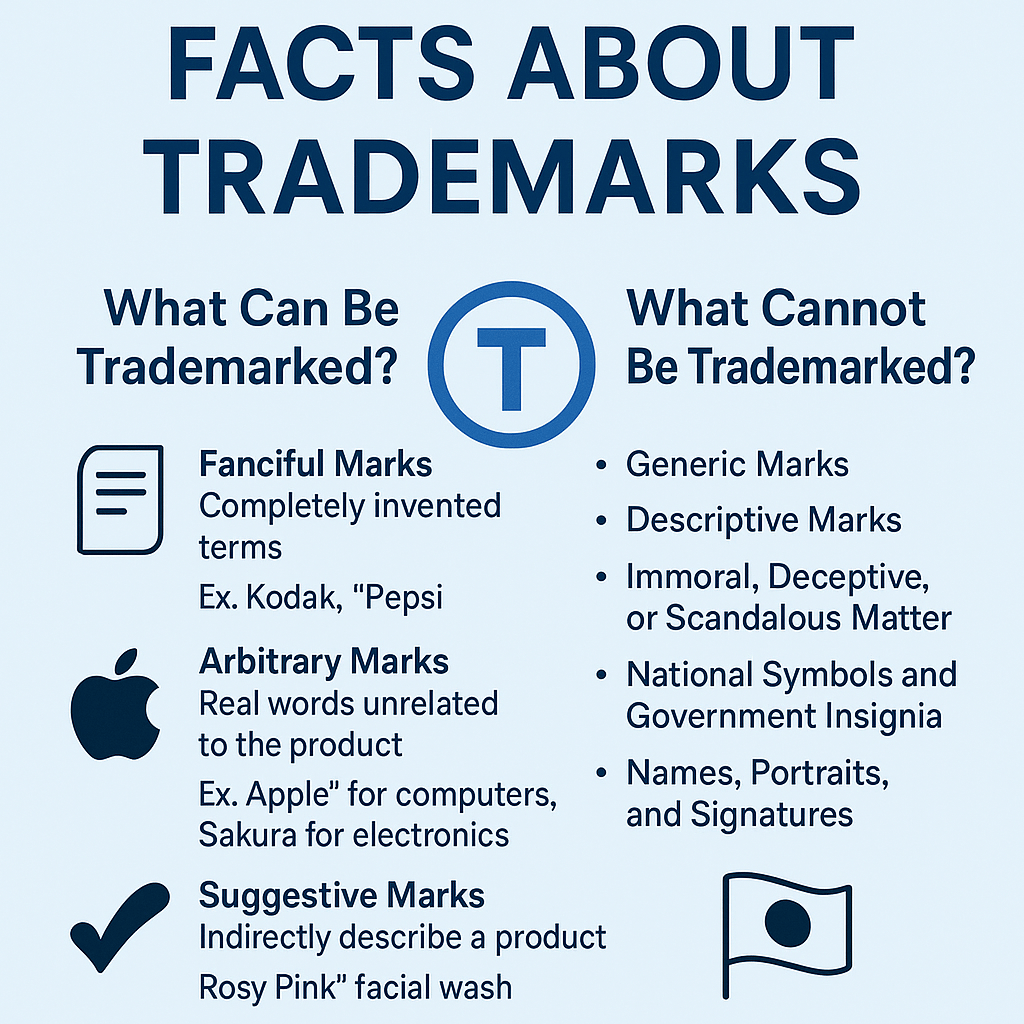
What Can Be Trademarked?
To qualify for trademark registration, a mark must be distinctive. These include:
Fanciful Marks
- Completely invented terms.
- Examples: “Kodak,” “Pepsi.”
Arbitrary Marks
- Real words unrelated to the product.
- Examples: “Apple” for computers, “Sakura” for electronics.
Suggestive Marks
- Indirectly describe a product, needing imagination.
- Examples: “Coppertone” for sunscreen, “Rosy Pink” facial wash.
Trademarks can also include designs, stamped containers, and logos. Adding color or using black and white can affect the scope of protection.
What Cannot Be Trademarked?
Certain marks are non-registrable under “absolute grounds”:
Generic Marks
- Refer to the product class itself.
- Example: “Milk” for dairy products.
Descriptive Marks
- Describe characteristics or functions.
- Example: “Creamy Yogurt” for yogurt.
These may only be registered if they acquire secondary meaning through use.
Immoral, Deceptive, or Scandalous Matter
- Including marks that falsely suggest connections with well-known entities or institutions.
National Symbols and Government Insignia
- Cannot use flags or official emblems.
Names, Portraits, and Signatures
- Require written consent, especially of living persons or former Philippine presidents.
Confusingly Similar Marks
- Similar to an already registered mark in a way likely to cause confusion.
Trade Names and Collective Marks
- Trade Name: Business name used to identify itself.
- Collective Mark: Used by multiple entities to indicate shared origin or qualities. Requires proper designation and control.
Trademark Rights and the “First to File Rule”
In the Philippines, ownership is obtained only through registration. This rule favors whoever first files a trademark application in good faith, regardless of prior usage.
Trademark Registration Process
- File an Application with the Intellectual Property Office (IPO).
- Formality Examination checks compliance with requirements.
- Publication for Opposition in the IPO Gazette allows objections.
- Issuance of Certificate if no opposition is successful.
- Declaration of Actual Use (DAU) must be filed periodically to maintain rights.
Failure to comply with DAU requirements may result in cancellation.
Duration and Renewal
Trademark registration lasts 10 years, with indefinite renewals for additional 10-year periods, provided the DAU is filed appropriately.
Rights of a Registered Trademark Owner
- Exclusive use of the mark on identical or similar goods/services.
- Prevent others from using confusingly similar marks.
- Right to use the mark in domain names.
- Legal presumption of validity and ownership.
The Doctrine of Unrelated Goods
Trademark protection does not extend to completely unrelated goods. For example, “Sakura” for electronics doesn’t block its use for perfumes—unless it’s a well-known mark.
Well-Known Marks and the Paris Convention
Well-known marks receive special protection, even if not registered in the Philippines, under the Paris Convention:
- Unregistered but well-known: Protection against identical/similar goods.
- Registered and well-known: Extended protection to unrelated goods.
Trademark Dilution
A well-known mark may suffer from dilution, categorized as:
- Blurring: Weakens its distinctiveness.
- Tarnishment: Harms its reputation.
Trademark Infringement
Occurs when someone uses a registered mark without permission, in a way that causes confusion. Must meet these elements:
- Registered trademark.
- Unauthorized reproduction or imitation.
- Commercial use.
- Connection to goods/services.
- Likelihood of confusion.
- Without owner’s consent.
Tests for Infringement
- Dominancy Test: Focuses on dominant features.
Remedies
- Civil damages and injunctions.
- Seizure and destruction of infringing goods.
- Criminal prosecution.
Trademark Infringement vs. Unfair Competition
| Basis | Trademark Infringement | Unfair Competition |
|---|---|---|
| Registration Required | Yes | No |
| Intent | Not required | Required |
| Focus | Confusing similarity | Deceptive behavior |
| Scope | Registered marks only | Broader, includes packaging and trade dress |
Madrid Protocol and International Registration
Allows applicants to file one trademark application valid in multiple countries. However, it has a five-year dependency on the home country’s registration.
Voluntary Licensing
Trademark owners may license their rights, provided:
- Quality control measures are in place.
- Anti-competitive clauses are avoided unless cleared by IPOPHL.
Key Takeaways
- Trademark protection is essential for brand identity.
- Registration is mandatory for enforcement in the Philippines.
- Distinctiveness is key to registrability.
- Well-known marks enjoy broader protection, even without registration.
- Trademark law includes clear rules for infringement, remedies, and international protection.
FAQs About Trademarks in the Philippines
1. Can I trademark a color or sound?
Yes, but it must be distinctive and not merely functional or decorative.
2. What is the cost of trademark registration?
Fees vary based on classification and type of filing. Check the IPOPHL website for up-to-date rates.
3. Can I file a trademark online?
Yes, through the IPOPHL eTMFile platform.
4. What happens if I miss the DAU deadline?
Your mark may be removed from the register or refused.
5. Can I trademark a hashtag or social media handle?
Yes, if it meets the criteria of distinctiveness and is used in commerce.
6. Is trademark protection worldwide?
No. You must register in each country or use international systems like the Madrid Protocol.
 Reliebo